

As we kick off our enterprise Data Mesh implementation, I’m both excited and humbled by the scale of what lies ahead. Data Mesh represents a paradigm shift in how organizations manage and leverage their data assets, and our team is now at the beginning of this transformative journey.
The Challenge Before Us
Building an enterprise Data Mesh from the ground up is no small feat. It’s a relatively new concept with few established industry-wide reference implementations to guide us. The challenge is magnified by the fact that Data Mesh crosses boundaries in the ever-evolving Data Engineering landscape, touching upon business, social, and technical disciplines simultaneously.
In these early stages, I found tremendous value in the Data Mesh Workstreams Road Map outlined in “Data Mesh Implementation” by Jean-Georges Perrin and Eric Broda. Their visualisation of the different workstreams provided me with a foundational vision for Data Mesh architecture and helped clarify the complex interplay between various components.
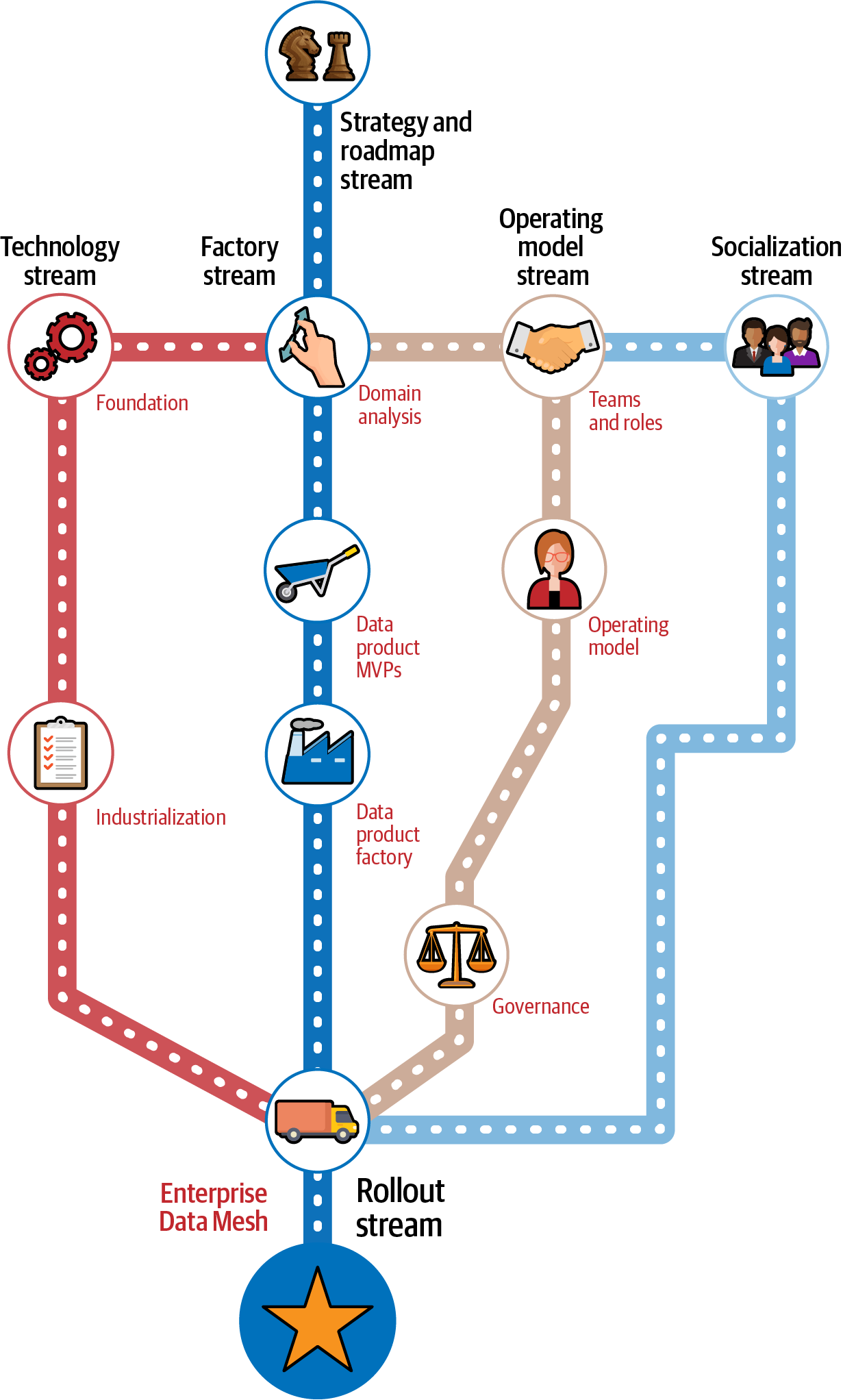
The Five Essential Streams of Data Mesh Implementation
Strategy and Roadmap Stream
This critical stream establishes both the business and technical vision for the enterprise Data Mesh, along with a concrete execution plan. Success here hinges on close collaboration between business stakeholders and technology teams. The process begins with a thorough assessment of the existing data landscape, identifying current capabilities and gaps, and culminates in risk evaluation and the creation of a governance framework to guide implementation.
Technology Stream
At the heart of the Data Mesh lies this stream, which builds and industrialises the technical components Its primary focus is to build a core technological foundation that underpins the entire Data Mesh architecture. The technology stream delivers a suite of foundational technology capabilities that streamline the discovery, consumption, sharing, and governance of data across the enterprise
Factory Stream
Employing a “test and learn” approach to deliver an initial set of proofs of concept and MVPs, culminating in the creation of repeatable processes to scale delivery of Data Products. The essence of the factory stream lies in its ability to translate theoretical models into tangible, operational results through a series of iterative and progressive steps.
Operating Model Stream
This stream defines the Data Product Owner role, structures the Data Product Team(s), and establishes the processes necessary to support an enterprise Data Mesh. It addresses the organisational aspects of delivering data products, ensuring the right people, roles, and workflows are in place for sustainable implementation.
Socialisation Stream
Often underestimated yet pivotal, the socialization stream serves as the conduit for cultural transformation within an organisation embarking on a Data Mesh journey. It communicates data-product success stories while building momentum for scaling. This stream goes beyond mere information sharing—it focuses on engaging, convincing, and rallying the entire organization around the new data paradigm.
Looking Ahead
The journey ahead won’t be easy—we’re charting relatively unexplored territory—but I’m fortunate to be working alongside a phenomenal team of experts who bring diverse perspectives and deep expertise to the table.
As we progress from these initial planning stages toward concrete implementation, I look forward to sharing our learnings, challenges, and victories. The Data Mesh approach represents not just a technical evolution but a fundamental rethinking of how data is approached in an organisation.
Stay tuned for updates as our Data Mesh implementation takes shape!
#DataMesh #DataStrategy #DataGovernance #DataArchitecture #DigitalTransformation #EnterpriseData #DataProducts #AI #Cloud #BigData #DataEngineering #TechLeadership #DataManagement #Agile #OperatingModel #CulturalTransformation
 Techie Ranch
Leave a comment